The standard rubric weights thesis, structure, evidence, mechanics, and citation. Large language models handle four of those five confidently on their own. A well-prompted model produces a defensible thesis, tidy structure, adequate mechanics, and plausible citations. The one it still struggles with is course-specific evidence, and even that gap has narrowed as models ingest more of the syllabus material.
Quick answer
Add rubric criteria that reward specificity to course readings, process evidence, revision quality, and argument grounded in course-specific context. Grade a small process portfolio alongside the final draft. Keep the traditional criteria, but reduce their share of the total score. The redesign takes about two hours per assignment and is durable across model updates.
Below is the reasoning, the five criteria we would add, a sample rubric section you can adapt, and a note on the extra grading time this actually costs in practice.
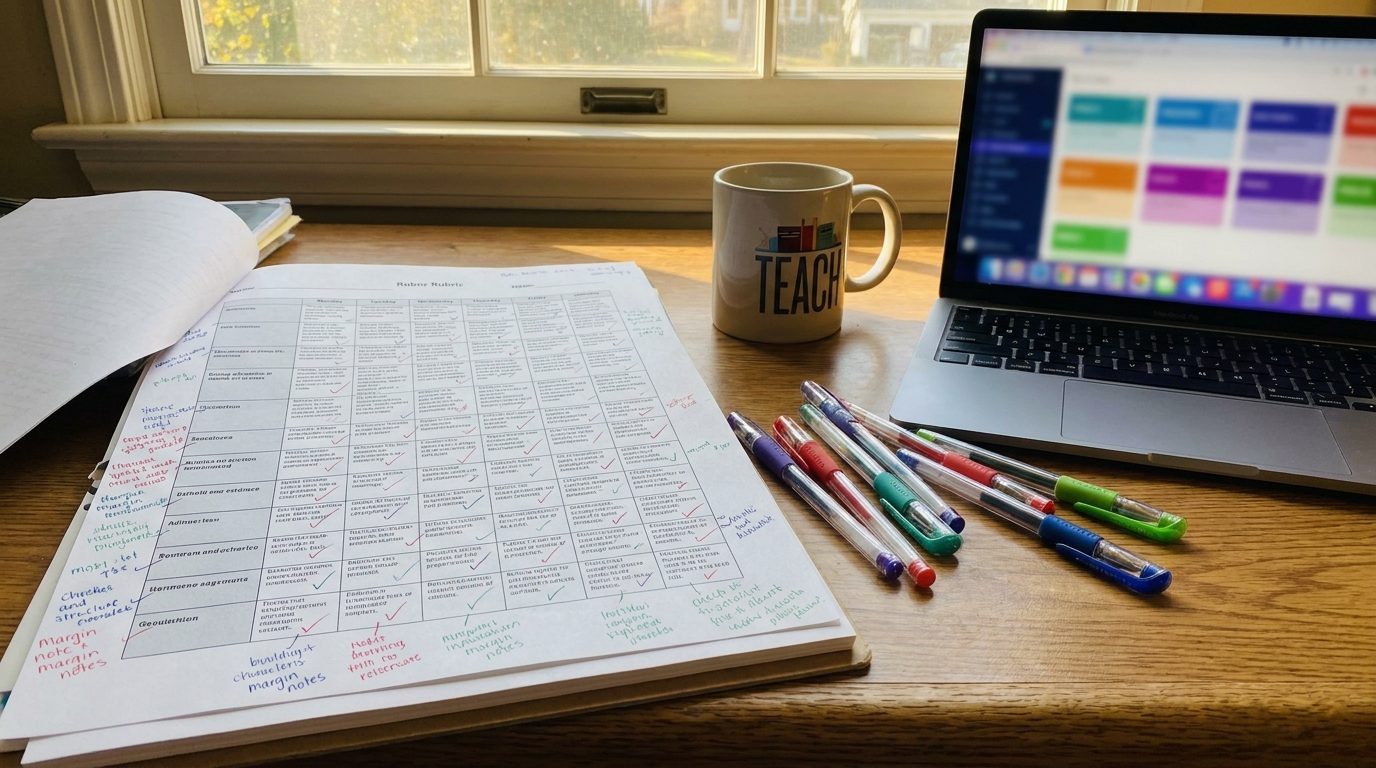
Why the standard writing rubric doesn't hold up
The result is that a rubric weighted heavily toward general competence rewards the wrong thing in the AI era. Students who used a model well and students who wrote independently end up close in score, and the detector conversation gets loaded up with the entire integrity question.
A rubric that rewards course-specific engagement does not need a detector to hold up.
The Working Educators editors
The five criteria to add
First, engagement with specific course readings. Not the presence of a citation, but a sentence that names a claim from the reading and does something with it. Second, revision evidence. A short annotated diff between draft and final, or a paragraph explaining what changed and why. Third, response to instructor feedback. Whether the student incorporated, argued against, or ignored specific comments from the previous draft.
Fourth, position under pressure. A short in-class or oral component in which the student defends their thesis for two minutes against a follow-up question. Fifth, course-specific context. Whether the argument connects to a class discussion, a lab, a case, or a local example that would not appear in a general model's training data.
Sample rubric section you can adapt
Under Engagement with Course Readings, one point for citing at least two assigned readings, two points for citing them accurately, three points for extending or challenging a claim from at least one. Under Revision Evidence, one point for submitting a draft and a final, two points for a marked-up draft, three points for a short reflection that identifies specific changes.
Under Position Under Pressure, zero points if the student cannot restate the thesis when asked, one point if they can, two points if they can name one counterargument, three points if they can respond to it. This section only requires two to three minutes per student and produces the strongest signal in the whole rubric.
How to grade it without doubling your time
The efficiency comes from making the added criteria fast to score. A yes/no check on whether a revision reflection was submitted takes seconds. A two-minute oral follow-up during class or office hours is faster than reading and grading a paragraph on the same content. The reflection paragraph is short by design.
The tradeoff is upfront prep. Building the rubric takes an hour or two. Explaining the changes to students takes ten minutes of class time. After that, per-paper grading time is comparable to the old rubric because the fast criteria offset the reduced weight on the slower ones.
When to combine with oral follow-up
For high-stakes assignments where integrity concerns are elevated, add a short oral defense on the same day the paper is due. Our oral defense guide covers the logistics for large sections. The rubric criterion above about position under pressure is designed to slot directly into that format.
For lower-stakes weekly writing, the reflection paragraph alone is usually enough. The point is not to police every submission. It is to make the assignments themselves reward the kind of engagement a model cannot fake. Pair this rubric work with the assignment redesign guide for the fuller picture.
Frequently Asked Questions
How much time does the redesign take?▼
About two hours per assignment for the first pass. Subsequent assignments in the same course take under an hour once the rubric template is in place.
Does this replace AI detection entirely?▼
For most course contexts, yes. The point of the redesign is that a strong rubric makes detection unnecessary as a primary tool. Detection can still play a small triage role for extreme cases.
What if students refuse to submit a revision reflection?▼
Make the reflection part of the assignment grade, not a separate requirement. Weight it enough that skipping it costs a full letter grade on the paper. Compliance rises quickly once students internalize the weight.
Does this work for large lecture courses?▼
The oral component is the constraint in large courses. Consider replacing it with a very short in-class writing prompt at the top of the next class, which serves a similar function without requiring per-student time.
Can I use this rubric for STEM writing?▼
Yes, and it often works better in STEM because the course-specific criteria map cleanly onto lab-specific or problem-specific engagement that general models handle poorly.
The Bottom Line
The rubric shift is smaller than it sounds. Most instructors already care about revision quality and course engagement. The change is moving those criteria from implicit praise in the margin comments to explicit points on the rubric where students can see them and plan around them.
The version of this work that has aged best pairs a redesigned rubric with a light oral component and a norm of AI use disclosure. None of the three requires a detector, and together they hold up across model updates in a way that any single detector-based policy does not.