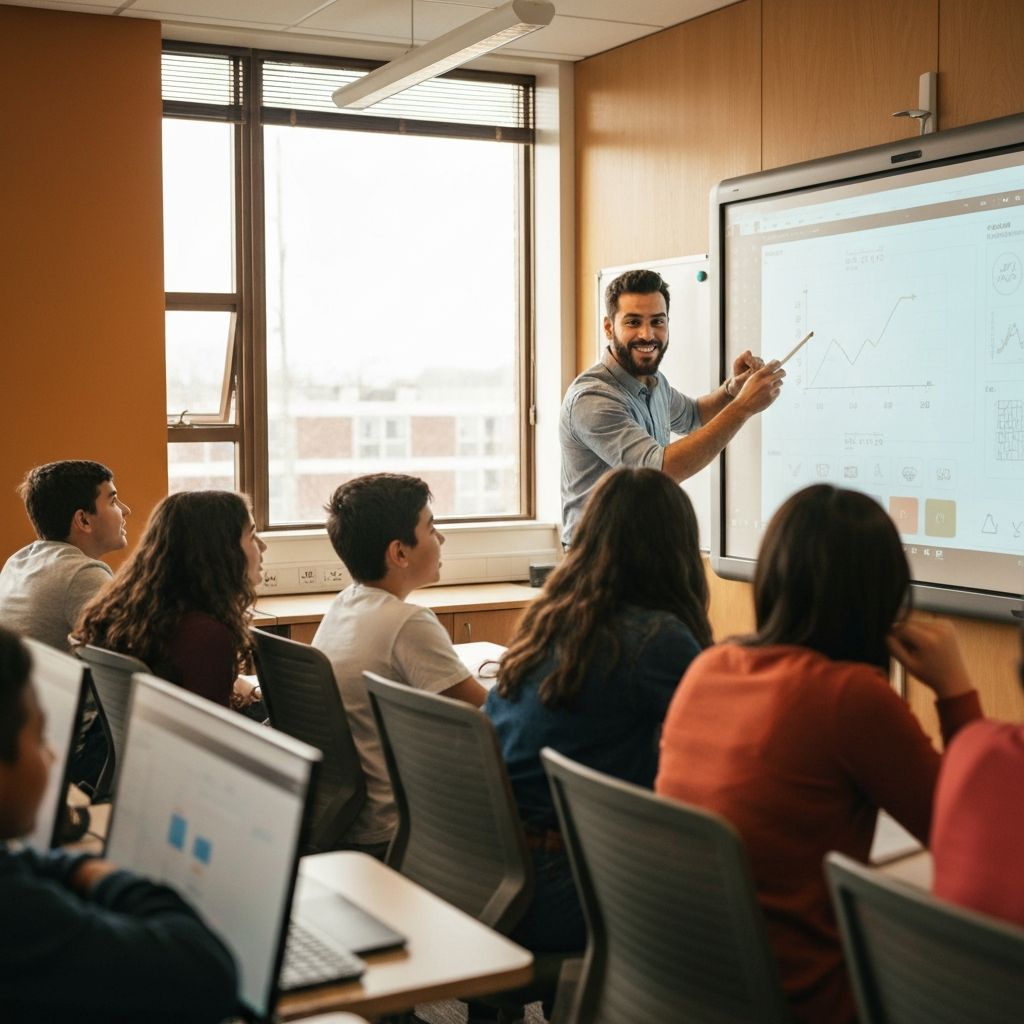
The conversation about AI in education has been dominated by fear: fear of cheating, fear of detection tools, fear of losing control. But across the country, thoughtful teachers are asking a different question: How can AI actually help me teach? This guide is for them.
The Nuance Most Coverage Misses
Working Educators is not anti-AI. We're not pro-AI either. We're pro-teacher , which means we believe educators should have the information and autonomy to make their own decisions about tools that affect their classrooms.
The reality is that AI is neither uniformly good nor uniformly bad for education. It depends on how it's used, by whom, and for what purpose. Teachers who understand that nuance are better positioned than those who either embrace AI uncritically or reject it entirely.
AI as a Teaching Tool (Not a Cheating Tool)
Here's what we're seeing from teachers who are using AI productively:
Lesson Planning & Differentiation
Teachers are using AI to generate multiple versions of materials at different reading levels, create practice problems with varying difficulty, and brainstorm engaging hooks for lessons.
"I asked ChatGPT to rewrite my Civil War primary source at a 6th-grade reading level while keeping the key historical content. What used to take me an hour took five minutes. I'm not outsourcing my job, I'm amplifying it."
Middle school history teacher, Texas
Generating Practice Problems
Math and science teachers use AI to create unlimited practice problems on specific concepts. English teachers generate grammar exercises. The teacher's expertise is in selecting and sequencing, AI handles the tedious generation.
"I needed 20 problems on polynomial division with varying complexity. I could write them myself or I could have AI generate them in seconds and spend my time actually helping students who are struggling."
High school math teacher, California
Feedback Scaffolding
Some teachers use AI to generate initial feedback on student drafts, which they then review and personalize. This doesn't replace teacher feedback, it accelerates the feedback loop so students get more iterations.
"I have 130 students. Before AI, most got one round of feedback before the final draft. Now some get three. That's more learning, not less."
High school English teacher, Georgia
Accommodations & IEP Support
Special education teachers use AI to quickly adapt materials for students with IEPs, simplifying language, creating visual supports, generating alternative assessments. AI doesn't replace the teacher's understanding of the student; it reduces the time spent on material adaptation.
Where to Draw the Line
Using AI productively requires clear thinking about boundaries. Here's how teachers are navigating:
Teacher Use vs. Student Use
Many teachers who use AI for lesson planning have strict policies against students using it for assignments. That's not hypocritical, it reflects different roles. A carpenter uses power tools; that doesn't mean their apprentice should skip learning hand tools.
The question isn't "is anyone allowed to use AI?" It's "what skills is this person supposed to be developing, and does AI use support or undermine that development?"
The "Would I Be Comfortable If Parents Saw This?" Test
One practical heuristic: Would you be comfortable explaining your AI use to parents, administrators, or colleagues? If yes, proceed. If you feel you'd need to hide or justify it, reconsider.
Redesigning Assignments for the AI Era
The best response to AI isn't just policy, it's pedagogy. Teachers are rethinking assignments with three principles:
Process Over Product
Instead of just grading final essays, teachers are grading the process: brainstorming notes, rough drafts, revision history, reflection journals. AI can generate a final product, but it can't fake a documented learning journey.
The In-Class Writing Renaissance
More teachers are bringing writing back into the classroom, timed writing, conferencing while students draft, observing the thinking process. This isn't about distrust; it's about creating conditions where authentic work is the path of least resistance.
Oral Assessment Models
Some teachers now require students to explain and defend their written work in brief oral conferences. A student who can't discuss their essay's argument probably didn't write it. This approach catches AI-generated work while also building valuable communication skills.
What's Working in Real Classrooms
Based on conversations with dozens of teachers, here are practices that are actually working:
- Transparent AI policies: Explain to students exactly what AI use is and isn't allowed, and why
- AI literacy units: Teach students how AI works, its limitations, and how to use it responsibly
- Collaborative detection: Instead of adversarial detection, some teachers have students disclose AI use and discuss it openly, using resources like a teacher's technical breakdown of how Turnitin detects AI to explain what the tools actually do
- Assignment audits: Regularly review assignments to ask "Could AI do this? If so, what's the point?"
- Low-stakes practice, high-stakes authenticity: Let AI assist on practice; require demonstrable skills on assessments
Resources
We believe teachers should lead AI training, not just receive it. Read our vision for reclaiming professional development. We're compiling resources for teachers navigating AI in their practice:
- Our Summer Reading list on AI and education
- Tool reviews for educators
- Policy tracker for your state and district